Francisco R. Candón ENES

Research

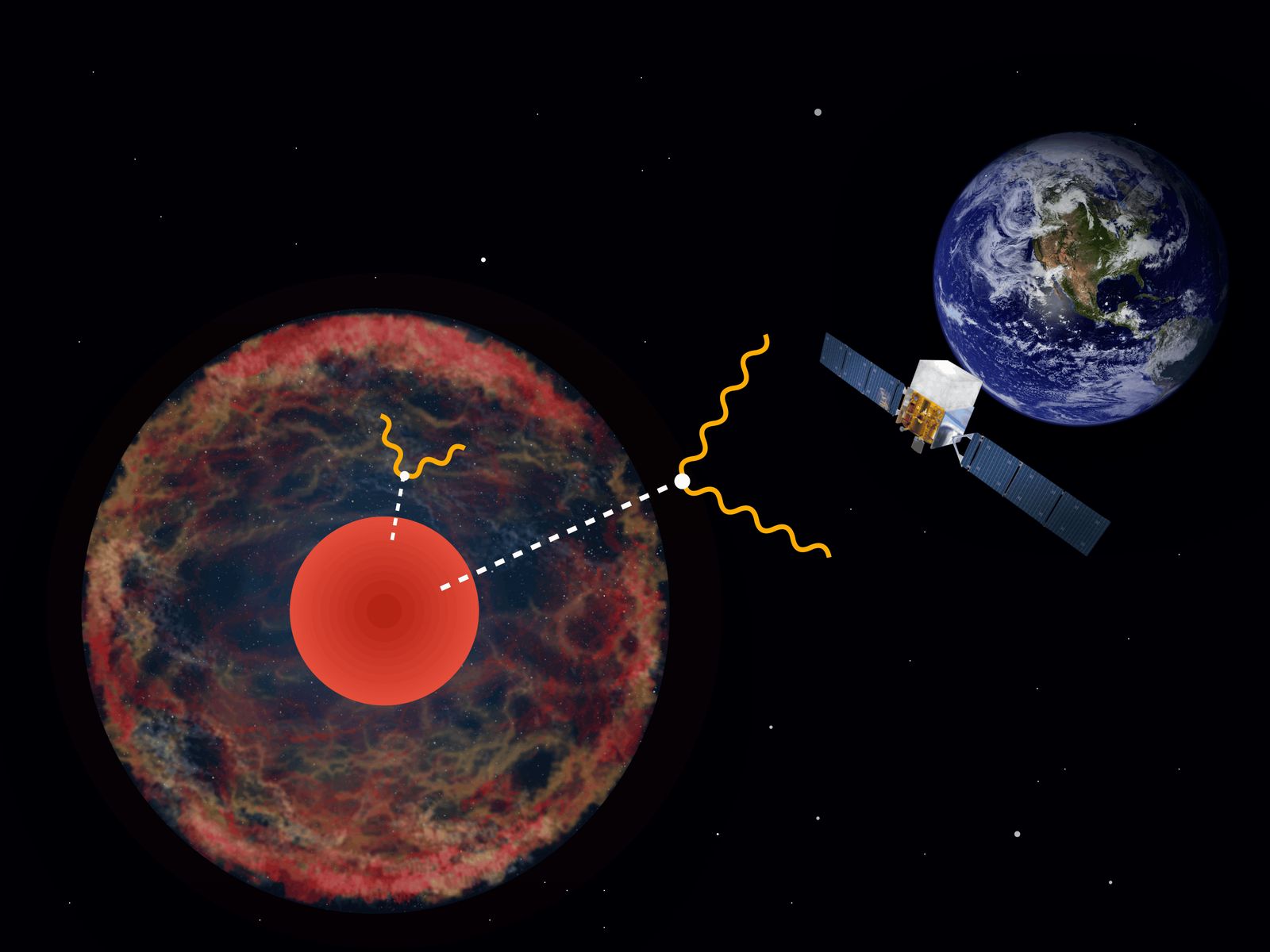
Illustration: axions from a star’s core decay into gamma-ray photons on their way to a space telescope near Earth
Cover art: axions escaping a star turn into gamma rays on their way to a space telescope

Stars are hotter and denser than any lab on Earth.

That makes stellar cores and core-collapse supernovae laboratories for feebly interacting particles: the QCD axion, axion-like particles (ALPs) and their relatives, all well-motivated dark-matter candidates. Made deep inside a star, they can reveal themselves as X-ray and gamma-ray signals, by decaying or by converting into photons in magnetic fields.

Comparing those signals with what telescopes see tells us which models survive.

PhD thesis · 2024–2027

Stars and supernovae as axion laboratories: searches for feebly interacting particles with X- and gamma-ray telescopes

The full chain, from star to signal

  1. 01

    Production

    Hot, dense plasma makes axions through photon–nucleus collisions, nucleon bremsstrahlung and nuclear transitions.

    My part: rates · MESA stellar models

  2. 02

    Escape

    Feebly interacting, they leave the star almost unimpeded, carrying energy out but no light.

    My part: emission spectra and fluxes

  3. 03

    Conversion or decay

    They turn back into photons in the magnetic field of the progenitor star, the Galaxy or a galaxy cluster, or by decaying in flight.

    My part: conversion and decay probabilities

  4. 04

    Detection

    The signal lands in X-ray and gamma-ray telescopes: NuSTAR, Fermi-LAT, eROSITA, XMM-Newton, Swift, Chandra and COMPTEL.

    My part: data reduction · likelihood analysis

Three ways to catch an axion

i · Hot, dense matter

Production in stars and supernovae

  • Type Ic supernovae probe decaying ALPs beyond SN 1987A [2]
  • The next Galactic Type Ib/c supernova could detect the QCD axion down to mₐ = 10⁻⁴ eV [1]
  • The Sun as a natural helioscope with NuSTAR [6, 7]
  • Heavy ALPs (30 to 500 keV) from the massive stars of M82 [5]
  • The axion–nucleon coupling from ⁵⁷Fe in Betelgeuse [4]
ii · Cosmic-scale converters

Diffuse fluxes and cluster magnets

  • The diffuse ALP background from every supernova in cosmic history, and its Fermi-LAT sensitivity [3]
  • Galaxy clusters as megaparsec-scale magnets: high-frequency gravitational waves turning into photons in the Virgo Cluster, seen with eROSITA and COMPTEL, one to two orders of magnitude beyond Milky Way bounds (in review)
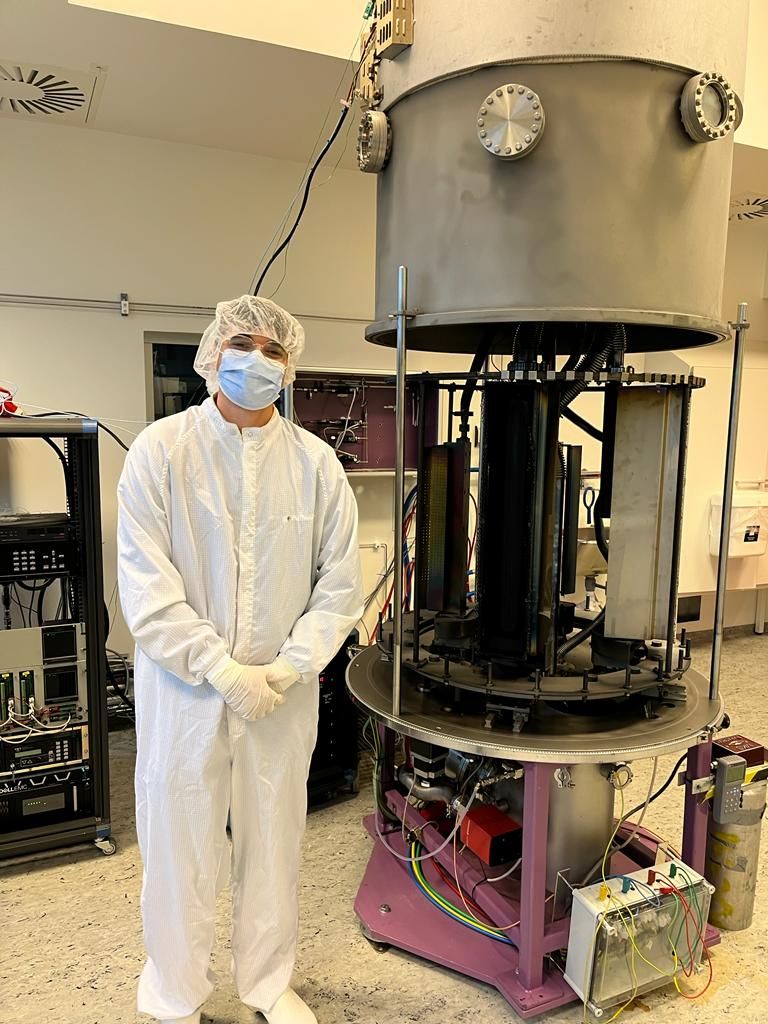
Francisco in a cleanroom suit next to the optics coating chamber at DTU Space

iii · Instruments

X-ray optics for IAXO

  • The NuSTAR glass-optics inventory and optics simulations for IAXO’s X-ray telescopes [8]
  • NuSTAR-type optics measured at the SOLEIL synchrotron, an input to BabyIAXO’s ray-tracing model [11]
  • The veto system and pressure settings of the IAXO Micromegas detector [12]
  • Contributions to the IAXO physics case [10]

What’s next

A thermometer for dying stars

In the last burning stages of a massive star the core heats from about 10 to 300 keV, thermally exciting nuclear transitions that emit axions. Each transition switches on at a different temperature, so the resulting X-ray line spectrum would act as a thermometer of the core and could flag a supergiant approaching collapse, much like pre-supernova neutrinos.

Magnetised plasmas, from stars to galaxies

The Wolf–Rayet star HD 45166 carries a 43 kG surface field, compact enough to convert much heavier axions than the Galactic field can, inside a dense, wind-fed magnetosphere that can resonantly boost the signal. NuSTAR, XMM-Newton and Swift data plus MESA models would give the first axion bounds from a Wolf–Rayet star. On galactic scales: the turbulent core of M82.

Diffuse backgrounds of new physics

If feebly interacting particles exist, every star and supernova in cosmic history has left a diffuse background of them. After the Virgo Cluster, the next target is the Coma Cluster, with archival XMM-Newton and NuSTAR data, for axions and for high-frequency gravitational waves alike.

Publications

Papers
12
Refereed
8
In Phys. Rev. Lett.
4
Citations
210
h-index
8

INSPIRE-HEP, 12 Oct 2026; the list below adds one paper in review and one in preparation. Most papers list authors alphabetically, as is usual in the field, so each entry says what I did. † Work from my MSc.

1

Phys. Rev. Lett. 136, 171001 (2026) Led analysis

Stripped-envelope supernovae for QCD axion detection

F. R. Candón, D. F. G. Fiorillo, Á. Gil Muyor, H.-T. Janka, G. G. Raffelt, E. Vitagliano

In plain words · Stars that lose their outer layers before exploding carry the strongest surface magnetic fields of any supernova progenitor, ideal for turning axions into gamma rays. The next such supernova in our Galaxy could reveal the QCD axion for masses down to 10⁻⁴ eV.

My part · Computed the expected gamma-ray signal from axion conversion in Type Ib/c progenitors at Fermi-LAT and derived the detection reach for the next Galactic supernova.

2

Phys. Rev. Lett. 137, 061004 (2026) Led analysis Corresponding author

Small progenitors, large couplings: Type Ic supernova constraints on radiatively decaying particles

F. R. Candón, D. F. G. Fiorillo, H.-T. Janka, B. F. A. van Baal, E. Vitagliano

In plain words · Type Ic supernovae come from compact stars that have lost their outer layers. Particles that decay into photons close to such a star still give a gamma-ray signal, because there is no envelope to absorb it. That reaches couplings SN 1987A cannot.

My part · Led the Fermi-LAT analysis of Type Ic supernovae and derived the constraints.

3

Phys. Rev. D 112, 015006 (2025) Analysis

Fresh look at the diffuse ALP background from supernovae

F. R. Candón, S. Ganguly, M. Giannotti, T. Kumar, A. Lella et al.

In plain words · Every supernova in cosmic history has added to a diffuse background of axion-like particles. We revisited how large that background is, and how well Fermi-LAT can see it.

My part · Interpreted the diffuse supernova ALP signal; computed the Fermi-LAT sensitivity to the diffuse background.

4

Phys. Rev. D 112, 123050 (2025) Led project

Probing the axion–nucleon coupling with supergiant stars

F. R. Candón, P. Casaseca, M. Giannotti, M. Kaltschmidt, J. Ruz, J. K. Vogel

In plain words · In the hot core of a supergiant like Betelgeuse, iron-57 nuclei are thermally excited; as they relax they can emit axions, which the Galaxy’s magnetic field turns into a sharp X-ray line. NuSTAR doesn’t see it, which limits how strongly axions couple to protons and neutrons.

My part · Built the MESA stellar models; computed axion production and conversion in the Galactic magnetic field; ran the NuSTAR data and likelihood analysis.

5

Phys. Rev. Lett. 134, 171004 (2025) Led analysis

NuSTAR bounds on radiatively decaying particles from M82

F. R. Candón, D. F. G. Fiorillo, G. Lucente, E. Vitagliano, J. K. Vogel

In plain words · Heavy particles made in the massive stars of the starburst galaxy M82 are slow enough to decay into X-rays on the 3.5 Mpc trip to Earth. Decay needs no magnetic field, which removes the biggest uncertainty of conversion searches.

My part · Reduced the NuSTAR data for M82; performed the spectral fits; derived the limits.

6

Phys. Rev. Lett. 135, 141001 (2025) Analysis

NuSTAR as an axion helioscope †

J. Ruz, E. Todarello, J. K. Vogel, F. R. Candón, M. Giannotti et al.

In plain words · The Sun’s magnetic field turns axion-like particles from its core into X-rays that NuSTAR can see. The result is a natural helioscope that reaches beyond ground-based experiments for very light particles.

My part · Reduced the NuSTAR solar observations; built the background model.

7

Submitted to JCAP (2026) Analysis

NuSTAR as an axion helioscope: probing axion–nucleon and axion–electron couplings

T. Zanzarella, F. R. Candón, M. Giannotti, M. Regis, J. Ruz et al.

In plain words · Extends the NuSTAR solar analysis from the axion–photon coupling to the axion’s couplings to nucleons and electrons.

My part · Analysed the NuSTAR solar observations.

Submitted to Phys. Rev. D (2026) Led analysis

Galaxy clusters as cosmic lenses for high-frequency gravitational waves

F. Lecce, F. R. Candón, A. Lella, A. Mirizzi, J. K. Vogel, T. Zanzarella

In plain words · Galaxy clusters are threaded by magnetic fields megaparsecs across. In the Virgo Cluster they would turn high-frequency gravitational waves into X- and gamma-ray photons; eROSITA and COMPTEL data improve on Milky Way bounds by one to two orders of magnitude.

My part · Proposed using wide-field instruments to exploit the large conversion volume of the Virgo Cluster; carried out the eROSITA and COMPTEL analysis.

In preparation Led analysis

Turbulent axion–photon conversion in the core of M82

F. R. Candón, D. F. G. Fiorillo, M. Giannotti, Á. Gil Muyor, E. Vitagliano, J. K. Vogel

In plain words · The core of M82 is threaded by tangled, small-scale magnetic fields. Conversion in such turbulent fields stays efficient for heavier axions than conversion in large, smooth ones.

My part · Built MESA models of the M82 stellar population; computed axion production (Primakoff, Compton, bremsstrahlung); ran the NuSTAR analysis. Started during a COST research stay in Padova.

8

arXiv (2026) Contributor

Overview and design optimization of a custom hybrid X-ray telescope for the International Axion Observatory (IAXO)

Y. Yu, J. Woo, I. Altunyurt, S. Basso, V. Burwitz et al. (incl. F. R. Candón)

My part · Studied the NuSTAR glass-optics inventory; ran optics simulations.

9

arXiv (2026) Contributor

The COSMIC WISPers white paper: the physics case for weakly interacting slim particles

A. Arza, D. Aybas, S. Balaji, R. Balkin, K. Bartnick et al. (incl. F. R. Candón)

My part · Wrote the sections on X-ray telescopes for WISP searches and on IAXO.

10

arXiv (2025) Collaboration member

The International Axion Observatory (IAXO): case, status and plans. Input to the European Strategy for Particle Physics

IAXO Collaboration, A. Arcusa et al. (incl. F. R. Candón)

My part · Member of the IAXO Collaboration.

11

JHEP 02, 159 (2025) Contributor

An accurate solar axion ray-tracing response of BabyIAXO

IAXO Collaboration, S. Ahyoune et al. (incl. F. R. Candón)

My part · Characterised NuSTAR-type X-ray optics at the SOLEIL synchrotron; the measurements are an input to the ray-tracing model.

12

J. Adv. Instrum. Sci. 2024, 549 (2024) Contributor

Using Micromegas detectors for direct dark matter searches: challenges and perspectives †

G. Luzón, T. Dafni et al. (incl. F. R. Candón)

My part · Worked on the veto system of the IAXO Micromegas detector; optimised the pressure settings for the axion-mass scan.

Complete record INSPIRE-HEP Google Scholar NASA ADS arXiv ORCID